


 Log in
 Sign Up





Car subscriptions promise a simple alternative to buying or leasing a vehicle, with one monthly payment often covering insurance, maintenance, and registration. But are they actually worth the cost? This guide explains how car subscriptions work, what they include, their advantages and drawbacks, and when buying a used vehicle may be the smarter financial choice for budget-conscious drivers.
What Is a Car Subscription Model?
For decades, drivers had two main options when they needed a vehicle: buy one or lease one. In recent years, a third option has emerged—the car subscription model. Often described as the "Netflix of cars," a vehicle subscription allows drivers to access a vehicle for a monthly fee without committing to ownership or a long-term lease.
Car subscriptions have attracted attention because they promise flexibility and convenience. Many programs bundle insurance, maintenance, roadside assistance, and registration into a single monthly payment. However, while subscriptions can be useful in certain situations, they are not always the most cost-effective choice, especially for budget-conscious drivers who plan to keep a vehicle for several years.
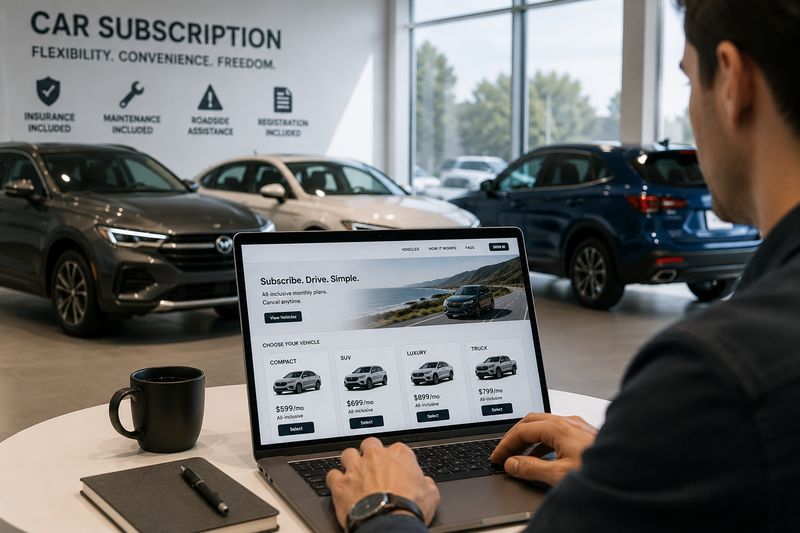
Understanding how car subscriptions work is the first step in deciding whether they make financial sense compared to buying or leasing a vehicle.
Definition of a Vehicle Subscription Service
A vehicle subscription service is a transportation program that allows customers to use a vehicle in exchange for a recurring monthly payment.
Instead of purchasing a car outright or signing a traditional lease agreement, subscribers pay a monthly fee that typically covers multiple vehicle-related expenses.
Depending on the provider, the monthly subscription may include:
- Vehicle use
- Insurance
- Routine maintenance
- Registration fees
- Roadside assistance
- Vehicle servicing
- Tire replacements in some cases
The structure is designed to simplify vehicle ownership by combining many costs into one predictable payment.
For example, a driver may pay $700 per month for a subscription that includes a midsize SUV, insurance, maintenance, and registration. Rather than dealing with separate insurance bills, repair costs, and registration renewals, everything is handled through the subscription provider.
Many subscription services operate on a month-to-month basis, allowing customers to return the vehicle or switch to another model with relatively little notice.
This flexibility is one of the main reasons vehicle subscriptions have gained popularity among certain groups of drivers.
How Car Subscriptions Differ From Traditional Car Ownership
The biggest difference between a car subscription and traditional ownership is that subscribers never build equity in the vehicle.
When you buy a vehicle, every payment contributes toward ownership. Once the loan is paid off—or if you purchase the vehicle outright—you own an asset that can later be sold or traded in.
With a subscription, the monthly payments only provide access to the vehicle. Once the subscription ends, the customer walks away without owning anything.
Consider two drivers:
- Driver A purchases a used Toyota Camry for $10,000.
- Driver B subscribes to a similar vehicle for $700 per month.
After two years, Driver A still owns a vehicle that may be worth several thousand dollars. Driver B may have spent over $16,000 in subscription payments but has no vehicle to sell and no ownership stake.
Car subscriptions also differ from ownership because:
- Vehicle swaps may be allowed.
- Insurance is often included.
- Maintenance is usually included.
- Long-term commitments are typically shorter.
- Monthly costs are often higher.
- Mileage restrictions may apply.
For drivers who value flexibility above all else, these trade-offs may be acceptable. For drivers focused on minimizing long-term transportation costs, ownership is often the more economical option.
Why Car Subscription Services Have Become Popular
Several factors have contributed to the growth of vehicle subscription programs.
One reason is changing consumer preferences. Many people are becoming accustomed to subscription-based services for entertainment, software, mobile phones, and other products. As a result, some consumers appreciate the idea of paying a monthly fee for transportation rather than purchasing a vehicle.
Another factor is flexibility.
A traditional auto loan may last five to seven years, while a lease often requires a commitment of two to four years. A subscription can sometimes be canceled after only a month or a few months, depending on the provider.
This appeals to people such as:
- Temporary residents
- Expats
- Business travelers
- Remote workers
- Individuals relocating for work
- Drivers who frequently change vehicles
For example, someone moving to the United States for a one-year work assignment may find a vehicle subscription more convenient than purchasing and later reselling a car.
The rise of digital technology has also made subscription programs easier to manage. Many providers allow customers to:
- Browse available vehicles online
- Complete applications digitally
- Schedule vehicle delivery
- Manage subscriptions through mobile apps
- Request vehicle swaps electronically
Some consumers also enjoy the ability to drive newer vehicles without committing to ownership.
However, popularity does not always mean affordability.
While subscriptions can provide convenience and flexibility, they often cost significantly more than owning a used vehicle over the long term. A driver paying $800 per month for a subscription may spend nearly $10,000 per year without building any equity. In contrast, that same amount could potentially purchase a reliable used vehicle outright.
How Does a Car Subscription Work?
At first glance, a car subscription may seem similar to renting a car, leasing a vehicle, or making monthly loan payments. In reality, it combines elements of all three. Subscribers gain access to a vehicle for a recurring monthly fee, often with several vehicle-related expenses bundled into a single payment.
The process is usually designed to be simple and flexible. Most subscription services allow customers to select a vehicle online, complete a digital application, and start driving within days. Depending on the provider, subscribers may also be able to swap vehicles, upgrade to different models, or cancel the service with relatively short notice.
Understanding exactly how the subscription process works is important because convenience often comes at a higher cost than traditional ownership.
Choosing a Vehicle
The first step in most subscription programs is selecting a vehicle from the provider's available inventory.
Unlike buying a vehicle, where thousands of options may be available through dealerships, private sellers, and auctions, subscription services typically offer a limited selection of vehicles within specific pricing tiers.
Depending on the provider, customers may choose from:
- Economy sedans
- SUVs
- Pickup trucks
- Luxury vehicles
- Electric vehicles
- Hybrid vehicles
Some services allow subscribers to browse available inventory through a website or mobile app. Others provide access to specific vehicle categories rather than guaranteeing a particular model.
For example, a customer may subscribe to a midsize SUV category and receive a vehicle such as a Toyota RAV4, Honda CR-V, Hyundai Tucson, or a similar model depending on availability.
Luxury-focused subscription programs may offer vehicles from premium brands such as Porsche, BMW, Mercedes-Benz, or Volvo.
Vehicle availability often depends on:
- Geographic location
- Inventory levels
- Subscription tier
- Seasonal demand
Unlike ownership, subscribers generally do not have complete control over vehicle selection. The available options are limited to what the service provider currently has in its fleet.
Monthly Subscription Payments
The core of the subscription model is the monthly payment.
Instead of making a down payment and financing a vehicle purchase, subscribers pay a recurring fee that grants access to the vehicle.
The monthly payment typically covers multiple services, which may include:
- Vehicle use
- Insurance
- Maintenance
- Registration
- Roadside assistance
- Routine servicing
This bundled structure is one of the main selling points of subscription services because it simplifies budgeting.
For example, instead of paying separately for:
- A $450 car payment
- A $180 insurance bill
- Registration fees
- Maintenance expenses
a driver may pay a single subscription fee of $850 per month.
While this simplicity is appealing, buyers should carefully compare total costs.
A subscription that costs $850 per month amounts to more than $10,000 per year. Over three years, the subscriber could spend more than $30,000 without owning a vehicle at the end of the agreement.
For drivers focused on minimizing transportation expenses, these long-term costs are an important consideration.
Insurance, Maintenance, and Registration Coverage
One of the biggest differences between subscriptions and traditional ownership is that many vehicle-related expenses are included in the monthly fee.
Most subscription providers include some combination of:
- Vehicle insurance
- Registration fees
- Routine maintenance
- Tire servicing
- Roadside assistance
- Scheduled inspections
This means subscribers generally do not need to:
- Shop for separate insurance coverage
- Pay annual registration fees
- Schedule routine maintenance themselves
- Worry about unexpected service expenses covered by the plan
For example, if the vehicle needs an oil change or tire rotation, the subscription provider may arrange and pay for the service.
This convenience can be especially attractive to drivers who do not want the responsibilities associated with vehicle ownership.
However, coverage varies significantly between providers.
Some subscription programs advertise "all-inclusive" pricing but still charge additional fees for:
- Excess wear and tear
- Accident damage
- Additional drivers
- Excess mileage
- Traffic violations
Because policies differ, customers should carefully review what is actually included before signing up.
Vehicle Swaps and Upgrades
Vehicle flexibility is one of the most heavily promoted features of many subscription programs.
Unlike traditional ownership or leasing, some subscription services allow customers to switch vehicles during the subscription period.
For example, a subscriber might:
- Use a compact sedan for commuting during the week.
- Switch to an SUV for a family vacation.
- Upgrade to a luxury vehicle for a special event.
The ability to swap vehicles varies considerably between providers.
Some programs allow:
- Unlimited vehicle swaps
- Monthly vehicle changes
- Seasonal vehicle changes
Others restrict swaps or charge additional fees.
This feature appeals to drivers whose transportation needs change frequently.
For example, a remote worker who occasionally takes long road trips may appreciate the ability to switch from an economy sedan to a larger SUV without purchasing a second vehicle.
However, swap flexibility often comes with higher subscription fees. Drivers who rarely change vehicles may end up paying for a feature they never use.
Subscription Cancellation Policies
Another major advantage often associated with car subscriptions is the ability to cancel more easily than a traditional lease or auto loan.
Many subscription providers offer:
- Month-to-month agreements
- Short-term commitments
- Flexible cancellation options
This can be beneficial for people who:
- Move frequently
- Work on temporary assignments
- Live abroad temporarily
- Are unsure about long-term transportation needs
For example, someone relocating to a new city for a six-month project may prefer a subscription over signing a multi-year lease.
However, cancellation policies vary widely.
Some providers require:
- Advance notice
- Minimum subscription periods
- Cancellation fees
- Vehicle return inspections
Others may impose penalties if the customer ends the subscription too early.
Before enrolling in a subscription program, customers should carefully review:
- Cancellation deadlines
- Minimum commitment requirements
- Early termination fees
- Vehicle return conditions
A service marketed as flexible may still involve costs that make cancellation more expensive than expected.
Types of Car Subscription Models
Not all car subscription programs work the same way. While the basic concept remains similar—paying a recurring fee for access to a vehicle—the structure, flexibility, and costs can vary significantly depending on the provider.
Some subscriptions focus on giving drivers access to a vehicle without ownership responsibilities. Others are offered directly by automakers, dealerships, or mobility companies. More recently, subscription models have expanded beyond entire vehicles and now include individual features such as heated seats, navigation systems, and advanced driver-assistance technologies.
Understanding the different types of car subscription models can help drivers determine whether a subscription fits their transportation needs and budget.
Vehicle Subscription Services
Vehicle subscription services are the most traditional form of car subscription.
These programs allow customers to use a vehicle for a monthly fee while the provider retains ownership of the car. The subscription often includes expenses that would normally be handled separately, such as:
- Insurance
- Maintenance
- Registration
- Roadside assistance
Many third-party subscription companies operate similarly to long-term vehicle rental services but with greater flexibility and more comprehensive coverage.
For example, a customer may subscribe to a midsize SUV for $850 per month. The monthly fee covers most vehicle-related expenses, allowing the driver to avoid a down payment, financing, and ownership responsibilities.
These services are commonly used by:
- Temporary residents
- Business travelers
- Remote workers
- Drivers relocating to a new city
- Individuals who need a vehicle for only a few months
The primary benefit is convenience. The primary drawback is cost. Over time, monthly subscription payments can exceed the cost of purchasing a reliable used vehicle.
Manufacturer-Based Subscription Programs
Some automakers have launched subscription programs directly through their own brands.
These services allow customers to drive vehicles produced by a specific manufacturer while maintaining a direct relationship with the company.
Examples have included programs from brands such as:
- Volvo
- Porsche
- BMW
- Mercedes-Benz
- Cadillac
In many cases, manufacturer subscriptions provide access to newer vehicles and premium customer support.
For example, a subscriber may choose a luxury SUV from a manufacturer's subscription program and later switch to a sports sedan from the same brand.
These programs often emphasize:
- Vehicle flexibility
- Access to new models
- Simplified ownership
- Premium customer experience
Manufacturer-based subscriptions can be appealing for drivers who enjoy driving newer vehicles and want access to different models without purchasing them.
However, they are usually among the most expensive subscription options available and are often targeted toward higher-income customers rather than budget-conscious drivers.
Dealer Subscription Programs
Some dealerships have developed their own subscription services using inventory from their local vehicle stock.
Unlike manufacturer programs, dealer subscriptions are usually operated by individual dealership groups rather than nationwide automotive brands.
A dealer subscription may allow customers to choose from vehicles available within the dealer's inventory, including:
- Sedans
- SUVs
- Pickup trucks
- Luxury vehicles
- Certified pre-owned vehicles
For example, a local dealership may offer a subscription program that allows customers to switch between several vehicles within the dealer's inventory every few months.
This model can provide more flexibility than a traditional lease while maintaining a relationship with the local dealership.
Dealer subscription programs are often more geographically limited than nationwide services. Vehicle availability, pricing, and swap options can vary significantly depending on the dealer's inventory and business model.
For drivers who want local support and occasional vehicle changes, dealer subscriptions may offer an attractive middle ground between leasing and traditional rental programs.
Fleet and Mobility Subscription Services
Fleet and mobility subscription services focus on transportation access rather than vehicle ownership.
These services are commonly used by:
- Corporate employees
- Business travelers
- Delivery professionals
- Urban residents
- Companies managing employee transportation
Many mobility providers operate large vehicle fleets that customers can access through monthly subscription plans.
Instead of committing to a specific vehicle, subscribers may gain access to an entire network of vehicles.
Depending on the service, subscribers may be able to:
- Reserve vehicles through a mobile app
- Switch vehicles frequently
- Use vehicles only when needed
- Access electric and hybrid fleets
For example, a consultant who travels frequently between cities may subscribe to a mobility service that provides access to vehicles in multiple locations.
This approach can eliminate many ownership responsibilities while providing transportation on demand.
Fleet-based subscriptions are often most useful for people whose transportation needs change frequently or who do not drive enough to justify vehicle ownership.
In-Car Feature Subscription Models
One of the newest and most controversial subscription trends involves paying monthly fees for features already installed in the vehicle.
Unlike traditional vehicle subscriptions, these programs do not provide access to a car. Instead, they provide access to specific functions within the vehicle.
Common subscription-based features include:
- Heated seats
- Heated steering wheels
- Remote start
- Advanced navigation
- Driver-assistance systems
- Smartphone connectivity services
- Performance upgrades
- Premium entertainment features
For example, a vehicle may already contain heated seat hardware, but the feature remains locked until the owner pays a monthly or annual subscription fee.
Similarly, some electric vehicles can receive software updates that unlock additional performance, range, or convenience features after purchase.
Automakers promote these programs as a way to allow customers to activate features only when needed.
For instance:
- A driver may subscribe to heated seats only during winter months.
- A family may activate advanced navigation for a vacation trip.
- An owner may temporarily unlock additional horsepower for a special event.
While manufacturers view this model as a new source of recurring revenue, many consumers have criticized the concept of paying ongoing fees for hardware already installed in the vehicle.
This debate has become one of the most controversial topics in the automotive industry and continues to shape discussions about the future of vehicle ownership.
Car Subscription vs. Buying vs. Leasing
When shopping for a vehicle, most drivers compare buying and leasing. Today, car subscriptions have added a third option to the decision-making process. Each model provides access to a vehicle, but the costs, flexibility, responsibilities, and long-term financial outcomes can be very different.
For budget-conscious consumers, understanding these differences is especially important. A payment that seems affordable on a monthly basis may end up costing thousands more over time depending on whether you subscribe, lease, or buy.
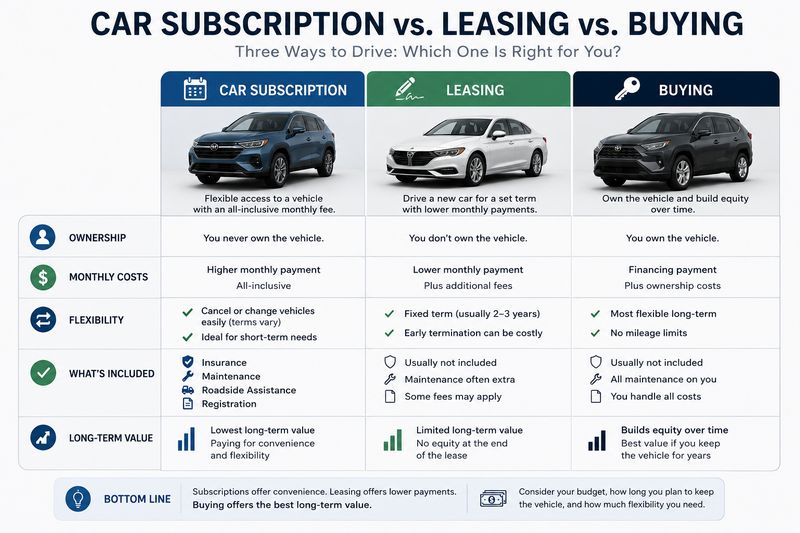
The best choice depends on your financial goals, driving habits, and how long you plan to keep the vehicle.
Key Differences Between Ownership, Leasing, and Subscriptions
The most significant difference between these three options is who owns the vehicle and what happens after your payments end.
When you buy a vehicle, either with cash or financing, you eventually become the owner. Once the loan is paid off, the vehicle is yours. You can keep it, sell it, trade it in, or modify it as you wish.
When you lease a vehicle, you pay for the right to use it for a specific period, usually two to four years. At the end of the lease, the vehicle is returned unless you choose to buy it.
A subscription works differently. You never build ownership. Instead, you pay for temporary access to a vehicle, often with insurance and maintenance included.
The basic differences can be summarized as follows:
Buying
- You own the vehicle.
- Equity builds over time.
- No mileage restrictions in most cases.
- Lowest long-term cost for many drivers.
- Responsible for maintenance and insurance.
Leasing
- Vehicle ownership remains with the leasing company.
- Lower monthly payments than buying in some cases.
- Mileage limits often apply.
- Limited modification options.
- Vehicle returned at lease end.
Subscription
- No ownership or equity.
- Insurance often included.
- Maintenance often included.
- Vehicle swaps may be available.
- Highest flexibility.
- Often the highest long-term cost.
For someone planning to drive the same vehicle for five years or more, ownership is usually the most economical choice. For someone staying in a city for only six months, a subscription may be more practical.
Upfront Costs Comparison
One reason subscriptions have attracted attention is their relatively low upfront costs.
Buying a vehicle often requires:
- A down payment
- Sales tax
- Registration fees
- Insurance setup costs
For example, purchasing a $15,000 used vehicle might require:
- $3,000 down payment
- Sales tax
- Registration costs
- Insurance activation
Total upfront expenses can easily exceed $4,000.
Leasing generally requires less money upfront but may still include:
- First month's payment
- Security deposit
- Acquisition fees
- Registration costs
A lease might require $1,500 to $3,000 before you can drive away.
Many subscription services require little or no down payment. In some cases, customers simply:
- Complete an application
- Pay the first month's fee
- Receive the vehicle
This can make subscriptions attractive for people who need transportation immediately but do not have thousands of dollars available for a down payment.
However, lower upfront costs do not necessarily mean lower overall costs.
Monthly Cost Comparison
Monthly payments are where the true differences often become apparent.
At first glance, a subscription may seem comparable to a car payment. However, the total financial picture can be very different.
Consider a simplified example:
Used Vehicle Purchase
- Vehicle payment: $280/month
- Insurance: $140/month
- Maintenance reserve: $50/month
- Total: Approximately $470/month
Lease
- Lease payment: $350/month
- Insurance: $140/month
- Total: Approximately $490/month
Subscription
- Subscription fee: $750/month
- Insurance included
- Maintenance included
- Total: Approximately $750/month
Although the subscription simplifies expenses, the monthly cost may still be substantially higher.
Over three years:
- $470/month ownership = about $16,920
- $490/month lease = about $17,640
- $750/month subscription = about $27,000
The ownership option also leaves the driver with a vehicle that still has resale value.
This is why many financial experts recommend looking beyond the monthly payment and calculating total transportation costs over several years.
Flexibility and Commitment Levels
Flexibility is where subscriptions often outperform both buying and leasing.
Buying a vehicle creates the longest commitment. Selling a vehicle later can take time and may result in depreciation losses.
Leasing offers more flexibility than ownership but still requires a contractual commitment that often lasts several years.
Breaking a lease early can be expensive.
Subscriptions are designed to provide maximum flexibility.
Depending on the provider, subscribers may be able to:
- Cancel after one month
- Upgrade vehicles
- Downgrade vehicles
- Switch between vehicle types
- Pause service in some situations
For example, a remote worker who moves between cities every few months may benefit from the ability to start and stop vehicle access without signing a multi-year contract.
Similarly, a family expecting a temporary change in transportation needs may appreciate the ability to switch from a sedan to an SUV without purchasing another vehicle.
The downside is that flexibility usually comes at a premium price.
Which Option Is Best for Different Drivers?
There is no single solution that works for everyone.
The best option depends on how long you need the vehicle, how much you drive, and your financial priorities.
Buying may be best for:
- Long-term vehicle owners
- Budget-conscious drivers
- Families planning to keep a vehicle for several years
- Drivers who want to build equity
- People who prefer full ownership control
Leasing may be best for:
- Drivers who want a new vehicle every few years
- People comfortable with mileage limits
- Consumers seeking lower payments on newer vehicles
- Drivers who prioritize warranty coverage
Subscriptions may be best for:
- Temporary residents
- Expats
- Business travelers
- Remote workers who relocate frequently
- Drivers who need maximum flexibility
- People uncertain about long-term transportation needs
For example, someone moving to the United States for an eight-month work assignment may find a subscription more practical than purchasing a vehicle and later reselling it.
On the other hand, a budget-conscious buyer planning to drive for several years will often spend far less by purchasing a reliable used vehicle. A well-maintained used Toyota, Honda, or Ford purchased through an auto auction can sometimes cost less over several years than a single year of subscription payments.
See How Much a Used Car Can Save You
Car subscriptions offer flexibility, but the monthly costs can add up quickly. Before committing to a subscription plan, compare the long-term cost of ownership with thousands of used vehicles available through U.S. auto auctions.
- ✅ Access to 150,000+ auction vehicles
- ✅ Free vehicle history reports
- ✅ Transparent pricing before purchase
- ✅ Affordable alternatives to monthly subscriptions
What Is an In-Car Subscription?
When most people hear the term "car subscription," they think about paying a monthly fee to access an entire vehicle. However, a newer trend has emerged in the automotive industry: in-car subscriptions.
Instead of subscribing to the vehicle itself, drivers pay recurring fees to activate specific features or services within a vehicle they already own or lease. In many cases, the hardware is already installed in the car, but access to certain functions is controlled through software.
Supporters argue that this approach gives drivers more flexibility and allows them to pay only for the features they use. Critics argue that it forces consumers to continue paying for equipment that is already physically present in the vehicle.
As vehicles become increasingly connected and software-driven, in-car subscriptions are becoming an important part of the automotive business model.
How In-Car Feature Subscriptions Work
An in-car subscription allows a driver to activate, maintain, or upgrade specific vehicle features through recurring monthly or annual payments.
Rather than purchasing a feature once at the time of sale, the customer pays for ongoing access.
For example, a vehicle owner may subscribe to:
- Heated seats
- Remote start
- Advanced navigation
- Driver-assistance systems
- Connected vehicle services
- Premium audio features
- Enhanced performance settings
The process is usually managed through the vehicle's software system.
A driver may purchase a subscription through:
- The manufacturer's mobile app
- The infotainment system
- An online owner portal
- A dealership service platform
Once payment is processed, the feature is activated remotely through a software update or digital authorization.
For example, a driver living in Florida may not need heated seats most of the year. Instead of paying for the feature upfront, they might activate it only during a winter trip to a colder region.
Similarly, a vehicle owner may subscribe to advanced navigation services for a long road trip and cancel them afterward.
This pay-as-you-go approach is one of the primary selling points used by manufacturers.
Software-Activated Vehicle Features
The growth of in-car subscriptions has been made possible by the increasing use of software-controlled vehicle systems.
Modern vehicles contain dozens of computers and electronic control modules that manage everything from climate controls to engine performance.
As a result, many features can be activated or deactivated through software without changing any physical hardware.
Examples of software-controlled features include:
- Heated seats
- Heated steering wheels
- Adaptive cruise control
- Lane-keeping assistance
- Automatic high beams
- Enhanced acceleration modes
- Additional electric vehicle range features
- Driver profiles and personalization settings
For example, a vehicle may leave the factory with heated seat hardware already installed. However, the heating function remains disabled until the owner purchases a subscription.
In some electric vehicles, software updates can unlock additional performance capabilities or enable new functionality long after the vehicle has been sold.
This represents a major shift from traditional automotive design.
Historically, if a vehicle came with heated seats, the owner had permanent access to them. Today, the hardware may be present while the software determines whether the feature can be used.
This change has generated considerable debate among consumers who question whether they should pay repeatedly for equipment already built into the vehicle.
Connected Vehicle Services and Digital Upgrades
Many of the most common subscriptions involve connected services rather than physical hardware.
Connected vehicle services rely on internet connectivity, cloud-based software, and communication between the vehicle and manufacturer servers.
Examples include:
- Real-time traffic updates
- Remote vehicle monitoring
- Smartphone vehicle controls
- Vehicle tracking
- Stolen vehicle assistance
- Emergency services
- Wi-Fi hotspot functionality
- Over-the-air software updates
For example, a driver may use a mobile app to:
- Start the vehicle remotely
- Lock or unlock doors
- Check fuel levels
- Monitor battery charging status
- Locate the vehicle in a parking lot
These features require ongoing data services and server infrastructure, which manufacturers often cite as justification for recurring subscription fees.
Some automakers also offer digital upgrades that can be purchased after the vehicle leaves the dealership.
Examples include:
- Improved navigation packages
- Enhanced driver-assistance features
- Additional entertainment options
- Performance enhancements
- Expanded electric vehicle functionality
This allows owners to customize their vehicles over time without purchasing a new car.
Why Automakers Are Expanding Subscription-Based Features
The rapid growth of in-car subscriptions is largely driven by changes in how automakers generate revenue.
Traditionally, manufacturers earned most of their profits when a vehicle was sold. After the sale, revenue opportunities were mostly limited to parts, repairs, and maintenance services.
Subscription models create a new source of ongoing income.
Instead of earning money only once, manufacturers can continue generating revenue throughout the life of the vehicle.
For example, if one million vehicle owners pay $10 per month for a connected service, the manufacturer generates:
- $10 million per month
- $120 million per year
from that feature alone.
In addition to recurring revenue, subscription programs offer several advantages for automakers:
- Increased customer retention
- Stronger brand engagement
- Opportunities for future upgrades
- Continuous software improvements
- Better understanding of customer behavior
Modern vehicles generate large amounts of data regarding how drivers use various features. Subscription systems help manufacturers identify which functions are most popular and where future software investments should be focused.
The shift toward electric vehicles and software-defined vehicles is accelerating this trend. As more vehicle functions become software-controlled, manufacturers gain greater ability to introduce new features through digital updates rather than physical modifications.
However, consumer reaction has been mixed.
Many drivers appreciate the convenience of connected services and remote vehicle management. Others argue that features such as heated seats, adaptive cruise control, or remote start should remain permanently available once the vehicle has been purchased.
Common Subscription Features in Modern Cars
As vehicles become more software-driven, automakers are finding new ways to charge for features after the vehicle has already been sold. Some subscription services provide access to entire vehicles, while others focus on specific functions built into the car.
Many of these features were traditionally purchased once during the initial vehicle purchase. Today, some manufacturers allow drivers to activate, deactivate, or upgrade features through monthly or annual subscription plans.
While some services provide ongoing value by relying on internet connectivity or cloud-based systems, others have sparked controversy because the required hardware is already installed in the vehicle.
Heated Seats and Steering Wheels
Heated seats and heated steering wheels are among the most discussed examples of subscription-based vehicle features.
In some modern vehicles, the heating hardware is installed at the factory regardless of whether the customer initially pays for access. The feature remains inactive until the owner purchases a subscription or unlocks it through software.
For example, a driver may pay:
- A monthly fee
- An annual fee
- A one-time activation fee
to enable heated seats.
Manufacturers argue that this approach allows customers to choose features only when they need them.
For instance, a driver living in a warm climate may decide not to pay for heated seats year-round. Instead, they may activate the feature temporarily during a winter vacation.
Critics argue that once the hardware is physically installed in the vehicle, owners should not be required to continue paying for access.
This debate has become one of the most visible examples of the growing subscription economy in the automotive industry.
Advanced Driver Assistance Systems (ADAS)
Advanced Driver Assistance Systems, commonly known as ADAS, include safety and convenience technologies designed to assist drivers while operating the vehicle.
Examples include:
- Adaptive cruise control
- Lane-keeping assistance
- Traffic jam assist
- Automatic lane changes
- Hands-free driving systems
- Parking assistance
- Automated highway driving
Many of these systems rely heavily on software, cameras, sensors, and vehicle computers.
Some manufacturers include basic versions of these features at no additional cost while reserving more advanced capabilities for subscription plans.
For example, a vehicle may come equipped with adaptive cruise control hardware, but a subscription may be required to unlock hands-free highway driving functionality.
Manufacturers often justify these subscriptions because:
- Features require ongoing software updates.
- Safety systems improve over time.
- Cloud-based services support certain functions.
- Mapping data requires maintenance.
However, consumers often question whether recurring payments are appropriate when the necessary hardware already exists in the vehicle.
Remote Start and Smartphone Controls
Remote connectivity services have become one of the fastest-growing categories of automotive subscriptions.
Many modern vehicles allow owners to interact with their cars through smartphone applications.
Common features include:
- Remote engine start
- Door lock and unlock controls
- Vehicle location tracking
- Fuel level monitoring
- Battery charge monitoring
- Climate control activation
- Vehicle status notifications
For example, on a cold winter morning, a driver can start the vehicle remotely from inside the house and warm the cabin before leaving.
Similarly, an electric vehicle owner can monitor charging progress from a smartphone without walking to the vehicle.
These services typically rely on:
- Cellular data connections
- Cloud servers
- Mobile applications
- Vehicle telematics systems
Because maintaining these systems involves ongoing infrastructure costs, many automakers charge recurring subscription fees.
Among all subscription-based vehicle features, connected services are often viewed as easier to justify because they require continuous support rather than simply unlocking hardware that already exists.
Navigation and Connected Services
Navigation systems have evolved significantly over the past decade.
Traditional built-in navigation systems relied on maps stored directly inside the vehicle. Modern systems increasingly depend on real-time data and cloud-based services.
Subscription-based navigation packages may include:
- Live traffic information
- Real-time route optimization
- Fuel price updates
- Weather data
- Parking availability information
- Voice assistant integration
- Destination sharing from smartphones
For example, a connected navigation system may automatically reroute a driver around an accident or construction zone based on real-time traffic conditions.
Many automakers bundle navigation subscriptions with broader connected-service packages that also include:
- Emergency assistance
- Vehicle health reports
- Theft recovery support
- Wi-Fi hotspot functionality
Because these services depend on external data providers and communication networks, subscription fees are often used to cover ongoing operating costs.
For drivers who regularly travel in unfamiliar areas, these services may provide meaningful value. For others who rely primarily on smartphone navigation apps, the additional cost may be difficult to justify.
Performance and Power Upgrades
Software-controlled performance upgrades are becoming increasingly common, especially among electric vehicles and high-performance models.
Modern vehicles often have performance capabilities that can be adjusted through software without changing any physical components.
Examples include:
- Increased horsepower
- Faster acceleration
- Improved throttle response
- Enhanced driving modes
- Expanded battery performance
- Higher speed limits
For example, an electric vehicle manufacturer may offer a subscription that unlocks additional acceleration or increases available power output.
Some automakers position these upgrades as optional enhancements that drivers can activate only when desired.
A driver might subscribe to a performance package for:
- Track days
- Road trips
- Special events
and later cancel the service.
Supporters appreciate the flexibility. Critics argue that consumers are paying repeatedly for capabilities already built into the vehicle.
This category is expected to grow as software-defined vehicles become more common.
Entertainment and Infotainment Features
Entertainment subscriptions have become a major focus for automakers seeking additional revenue opportunities.
Many vehicles now function as connected digital platforms, offering features similar to smartphones and tablets.
Subscription-based infotainment services may include:
- Premium audio streaming
- Video streaming services
- Rear-seat entertainment systems
- Advanced voice assistants
- Internet browsing capabilities
- App store access
- Gaming platforms
- Expanded multimedia features
For example, passengers in a modern electric vehicle may stream movies, listen to premium music services, or play games directly through the vehicle's infotainment system.
Some manufacturers also offer premium user interface packages that provide:
- Enhanced graphics
- Additional customization options
- Expanded display functionality
- Personalized driver experiences
Unlike heated seats or steering wheel subscriptions, entertainment services often involve third-party content providers, making recurring fees more familiar to consumers.
However, these costs can add up quickly. A driver paying separate monthly fees for connectivity, entertainment, navigation, and remote services may eventually spend hundreds of dollars per year beyond the original vehicle purchase price.
Why Automakers Are Moving to Subscription Models
For most of automotive history, manufacturers earned the majority of their revenue when a vehicle was sold. Once the customer drove away from the dealership, future income opportunities were largely limited to repairs, maintenance, financing, and replacement vehicle purchases.
Today, the industry is changing. Modern vehicles are increasingly connected to the internet, controlled by software, and capable of receiving updates long after they leave the factory. These technological changes have created new opportunities for automakers to generate ongoing revenue through subscriptions.
From heated seats and navigation services to advanced driver-assistance features, manufacturers are introducing subscription-based products that allow them to continue earning money throughout a vehicle's lifespan. While consumers often focus on the costs, automakers see subscription models as a major part of the future automotive business.
Creating Recurring Revenue Streams
One of the biggest reasons automakers are embracing subscriptions is the opportunity to generate recurring revenue.
Traditionally, vehicle sales were one-time transactions. A manufacturer sold a vehicle and received payment only once. After that, the owner could use most features indefinitely without making additional payments to the automaker.
Subscription services change this model.
Instead of receiving revenue only at the time of sale, manufacturers can collect monthly or annual payments for ongoing access to features and services.
For example, if an automaker charges:
- $10 per month for connected services
- $15 per month for advanced navigation
- $20 per month for driver-assistance upgrades
those fees continue generating revenue long after the vehicle has been sold.
The financial impact can be enormous.
If one million vehicle owners subscribe to a service costing $10 per month, the manufacturer generates:
- $10 million every month
- $120 million every year
from a single subscription product.
This predictable income stream is attractive because it is less dependent on fluctuations in vehicle sales and economic conditions.
From a business perspective, recurring revenue helps stabilize earnings and creates new growth opportunities.
Improving Customer Retention
Subscription programs also help manufacturers maintain ongoing relationships with customers.
In the past, many drivers had little interaction with the manufacturer after purchasing a vehicle. The next contact often occurred years later when it was time to buy another car.
Connected subscription services create regular engagement between drivers and automakers.
For example, customers may use:
- Manufacturer mobile apps
- Connected vehicle platforms
- Subscription management portals
- Remote vehicle services
every day.
This continuous interaction keeps the brand visible and encourages customer loyalty.
A driver who regularly uses a manufacturer's app to:
- Start the vehicle remotely
- Monitor battery charging
- Access navigation services
- Manage subscriptions
is more likely to remain connected to that brand's ecosystem.
Automakers hope that stronger customer engagement will increase the likelihood of future vehicle purchases.
For example, a customer satisfied with a connected service package may be more inclined to purchase another vehicle from the same manufacturer when it is time to upgrade.
Expanding Software-Defined Vehicle Capabilities
Modern vehicles contain more software than ever before.
Many automotive functions that once relied solely on mechanical systems are now controlled through electronic modules and software updates.
Examples include:
- Driver-assistance systems
- Climate controls
- Powertrain settings
- Infotainment systems
- Navigation services
- Battery management systems
- Performance modes
As vehicles become increasingly software-defined, manufacturers can introduce new features after the vehicle has already been delivered.
For example, an electric vehicle owner may receive:
- Improved battery management software
- Enhanced acceleration modes
- New navigation features
- Updated driver-assistance capabilities
through over-the-air updates.
Subscription models allow automakers to monetize these improvements.
Instead of selling a feature only once, they can offer:
- Monthly access
- Annual plans
- Feature-specific subscriptions
- Upgrade packages
This approach transforms vehicles into evolving products rather than static purchases.
From the manufacturer's perspective, software-defined vehicles create opportunities for long-term revenue generation without requiring major hardware changes.
Collecting Vehicle Usage Data
Connected vehicles generate enormous amounts of data.
Every day, modern vehicles can record information related to:
- Driving habits
- Feature usage
- Navigation patterns
- Vehicle performance
- Charging behavior
- Climate control settings
- Software interactions
Subscription systems often help manufacturers understand how customers use their vehicles.
For example, automakers can learn:
- Which features are used most often
- Which upgrades customers value
- Which services are rarely activated
- How drivers interact with vehicle technology
This information helps manufacturers make decisions about:
- Future product development
- Software improvements
- Subscription pricing
- Feature prioritization
For example, if data shows that a large percentage of drivers regularly use remote-start features, manufacturers may invest additional resources into expanding those services.
While this data can help improve products, it has also raised privacy concerns among some consumers.
Many drivers want greater transparency regarding:
- What data is collected
- How the information is used
- Who has access to the data
- Whether information is shared with third parties
As subscription-based vehicles become more common, data privacy is expected to remain an important topic of discussion.
Building Long-Term Customer Relationships
Perhaps the most significant goal behind automotive subscriptions is building ongoing customer relationships.
Historically, vehicle ownership followed a simple pattern:
- Customer buys a vehicle.
- Customer drives it for several years.
- Customer returns when ready for another purchase.
Subscription models create continuous engagement instead of occasional interactions.
Manufacturers can maintain regular contact through:
- Mobile apps
- Software updates
- Subscription renewals
- Feature upgrades
- Connected services
- Customer support platforms
This relationship often extends throughout the entire ownership experience.
For example, a driver may purchase a vehicle and later subscribe to:
- Navigation services
- Advanced safety features
- Entertainment packages
- Performance upgrades
Over time, the customer becomes increasingly connected to the manufacturer's ecosystem.
From a business standpoint, long-term relationships are valuable because retaining existing customers is often less expensive than acquiring new ones.
Manufacturers hope subscription models will increase customer loyalty while creating additional opportunities to introduce new services and upgrades throughout the vehicle's life.
Benefits of Car Subscription Services
Although car subscriptions are often criticized for their long-term cost, they do offer several advantages that appeal to certain drivers. The main selling points are convenience, flexibility, and reduced responsibility. Instead of dealing with vehicle ownership, financing, insurance shopping, and maintenance scheduling, subscribers typically receive a simplified transportation solution for a single monthly payment.
For some people, especially those who need a vehicle temporarily or frequently change vehicles, the benefits can outweigh the higher monthly cost. Understanding these advantages can help drivers determine whether a subscription fits their lifestyle and transportation needs.
Lower Upfront Costs
One of the biggest advantages of car subscription services is the relatively low upfront financial commitment.
Buying a vehicle often requires:
- A down payment
- Sales tax
- Registration fees
- Insurance activation costs
- Financing approval
Even purchasing a modest used vehicle may require several thousand dollars upfront.
For example, a buyer purchasing a $12,000 used car might need:
- $2,000–$3,000 as a down payment
- Registration fees
- Initial insurance payments
before driving the vehicle home.
Many subscription services eliminate most of these initial expenses.
In many cases, customers only need to:
- Complete an application
- Pay the first month's fee
- Meet eligibility requirements
This can be attractive for drivers who need transportation immediately but do not have enough cash available for a down payment.
For example, someone relocating for a new job may prefer paying $800 for the first month of a subscription rather than spending several thousand dollars upfront to purchase a vehicle.
Access to Newer Vehicles
Many subscription programs focus on relatively new vehicles that are still covered by manufacturer warranties and equipped with modern technology.
Subscribers often gain access to vehicles that include:
- Advanced safety systems
- Modern infotainment features
- Smartphone connectivity
- Driver-assistance technologies
- Improved fuel efficiency
For example, a subscriber may be able to drive a one- or two-year-old SUV with adaptive cruise control, lane-keeping assistance, and wireless smartphone integration without committing to ownership.
Newer vehicles often provide:
- Better reliability
- Lower maintenance risk
- Updated safety features
- Improved driving comfort
This can be particularly appealing for drivers who value modern technology but do not want the financial commitment associated with purchasing a new vehicle.
Some subscription services also refresh their fleets regularly, allowing customers to drive newer models more frequently than they might through traditional ownership.
Flexible Vehicle Choices
Vehicle flexibility is one of the features that most clearly separates subscriptions from buying and leasing.
When you purchase a vehicle, you are typically committed to driving the same car for several years. Leasing also limits your flexibility because ending a lease early can be expensive.
Many subscription services allow customers to change vehicles based on their current needs.
Depending on the provider, subscribers may be able to switch between:
- Sedans
- SUVs
- Pickup trucks
- Electric vehicles
- Luxury vehicles
For example:
- A commuter may use a fuel-efficient sedan during the workweek.
- A family may switch to a larger SUV for a vacation.
- A business professional may upgrade to a premium vehicle for a special event.
This flexibility can be valuable for people whose transportation needs change throughout the year.
Drivers who enjoy experiencing different vehicles without purchasing multiple cars may find this feature especially appealing.
Simplified Ownership Experience
Many people dislike the responsibilities that come with vehicle ownership.
Owning a vehicle often means managing:
- Insurance policies
- Maintenance schedules
- Registration renewals
- Repair appointments
- Warranty claims
- Roadside assistance services
A subscription service typically bundles many of these responsibilities into one package.
Instead of coordinating multiple services and payments, subscribers often receive a single monthly bill.
For example, if the vehicle requires routine maintenance, the subscription provider may:
- Schedule service
- Coordinate repairs
- Cover eligible maintenance costs
This simplified experience appeals to people who value convenience and prefer to spend less time managing vehicle-related tasks.
For busy professionals, frequent travelers, and people unfamiliar with vehicle ownership requirements, this can be a significant benefit.
Maintenance and Insurance Included
One of the most attractive aspects of many subscription programs is that insurance and maintenance are often included in the monthly fee.
For traditional vehicle owners, these expenses can be unpredictable.
Maintenance costs may include:
- Oil changes
- Tire replacements
- Brake service
- Battery replacement
- Unexpected repairs
Insurance costs can also vary significantly depending on:
- Driving history
- Vehicle type
- Location
- Coverage levels
With many subscription services, these costs are bundled together.
For example, a subscriber paying $850 per month may receive:
- Vehicle access
- Insurance coverage
- Scheduled maintenance
- Roadside assistance
- Registration services
This makes monthly budgeting easier because transportation costs become more predictable.
Drivers do not need to spend time comparing insurance providers or worrying about routine service expenses.
However, customers should still review the details carefully because coverage levels and included services differ from one provider to another.
Ideal for Short-Term Transportation Needs
Car subscriptions are often most valuable when a vehicle is needed for a limited period.
For example, subscriptions can work well for:
- Temporary residents
- International visitors
- Expats
- Traveling professionals
- Seasonal workers
- Students attending short-term programs
Consider a remote worker moving to another city for six months.
Purchasing a vehicle would require:
- Finding a suitable vehicle
- Completing registration
- Obtaining insurance
- Selling the vehicle later
A subscription may simplify the process by providing transportation for the exact period needed without long-term commitments.
Similarly, a family waiting for a new vehicle order to arrive may use a subscription as a temporary transportation solution.
This flexibility is often the strongest argument in favor of subscriptions.
While subscriptions are usually more expensive than ownership over several years, they can be practical when transportation needs are temporary or uncertain.
Drawbacks of Car Subscription Models
Car subscription services offer convenience and flexibility, but they are not without disadvantages. In fact, many of the concerns raised by consumers involve the long-term financial impact of subscriptions and the growing trend of paying recurring fees for products or features that people traditionally owned outright.
For drivers focused on saving money, it is important to look beyond the convenience of a single monthly payment and evaluate the total cost over time. In many cases, subscriptions can become significantly more expensive than buying a vehicle, especially for people who plan to drive the same car for several years.
Before committing to a subscription service, drivers should understand the potential drawbacks and limitations that often accompany these programs.
Higher Long-Term Costs
The most common criticism of car subscriptions is cost.
While subscriptions often eliminate large upfront expenses, the monthly fees can add up quickly over time.
For example, consider a subscription that costs $850 per month.
Over:
- One year: $10,200
- Three years: $30,600
- Five years: $51,000
At the end of those payments, the subscriber owns nothing.
Compare that to purchasing a reliable used vehicle for $12,000 to $15,000. Even after accounting for maintenance, insurance, and repairs, ownership often costs significantly less over the long term.
For example, a buyer who purchases a used Toyota Camry or Honda Accord may spend:
- Several thousand dollars upfront
- Lower monthly operating expenses
- Occasional maintenance costs
but still retain a vehicle that has resale value years later.
This is why subscriptions are often most practical for short-term transportation needs rather than long-term vehicle use.
For budget-conscious consumers, the long-term math frequently favors ownership.
Mileage Restrictions
Many subscription services impose mileage limits similar to those found in traditional leases.
These restrictions are designed to protect the provider's vehicle fleet from excessive depreciation.
Typical subscription plans may include:
- 500 miles per month
- 1,000 miles per month
- 1,500 miles per month
Additional mileage often results in extra charges.
For example, a subscriber who exceeds the monthly limit may be charged:
- Per-mile fees
- Overage penalties
- Higher subscription tiers
This can become expensive for commuters, delivery drivers, or anyone who drives frequently.
Consider a driver with a daily commute of 50 miles.
That driver could easily accumulate:
- 250 miles per week
- 1,000 miles per month
- More than 12,000 miles annually
before accounting for errands, road trips, and personal travel.
Drivers who regularly exceed mileage allowances may find ownership far more economical than paying ongoing mileage penalties.
Limited Vehicle Availability
Although subscription providers advertise flexibility, vehicle selection is often more limited than many consumers expect.
When purchasing a vehicle, buyers can search among:
- Dealership inventories
- Private sellers
- Auto auctions
- Online marketplaces
Subscription customers are restricted to vehicles currently available within the provider's fleet.
Availability may depend on:
- Geographic location
- Vehicle demand
- Subscription tier
- Seasonal inventory levels
For example, a customer may want a specific SUV model but discover that only sedans are available in their area.
Likewise, a driver hoping to upgrade to a larger vehicle for a family trip may find that all available SUVs have already been reserved.
Luxury and specialty vehicles are often even more limited.
This lack of guaranteed availability can be frustrating for customers who expect unlimited vehicle choices.
Subscription Price Increases
Another concern is the possibility of future price increases.
When you purchase a vehicle, the ownership cost becomes more predictable over time. Once the loan is paid off, the vehicle can often be driven for years with only maintenance, insurance, and operating expenses.
Subscription pricing works differently.
Providers may increase prices due to:
- Inflation
- Fleet costs
- Insurance expenses
- Vehicle shortages
- Increased demand
- Operational costs
For example, a subscription that initially costs $700 per month could increase to $800 or $900 per month during the following year.
Unlike a fixed-rate auto loan, subscribers have less control over future pricing.
This uncertainty can make long-term budgeting more difficult.
Drivers who depend on a subscription for transportation may eventually find themselves paying significantly more than they originally anticipated.
Feature Lockouts After Cancellation
One of the most controversial aspects of modern subscription models involves software-controlled vehicle features.
In some cases, a driver may lose access to certain functions when a subscription ends.
Examples include:
- Heated seats
- Heated steering wheels
- Premium navigation systems
- Remote-start capabilities
- Advanced driver-assistance features
- Performance upgrades
For example, a vehicle may physically contain heated-seat hardware, but the feature becomes disabled once the subscription expires.
Similarly, remote smartphone controls may stop functioning if the owner chooses not to renew a connected-services package.
Many consumers find this frustrating because the hardware remains installed in the vehicle.
Critics argue that buyers should not lose access to features already built into the car simply because they stop making monthly payments.
This issue has become one of the most widely debated topics surrounding software-defined vehicles.
Ownership Confusion and Lack of Equity
Perhaps the most important drawback for many drivers is the lack of ownership.
With a subscription, customers pay for access rather than ownership.
No matter how long the payments continue:
- The subscriber never owns the vehicle.
- No equity is created.
- No trade-in value is accumulated.
- No asset remains after cancellation.
For example, a driver paying $800 per month for four years will spend:
- More than $38,000
yet still return the vehicle at the end of the subscription period.
In contrast, a vehicle owner who spends the same amount may still possess a vehicle worth thousands of dollars.
This distinction is especially important for budget-minded consumers.
Vehicle ownership provides:
- Long-term value
- Resale opportunities
- Trade-in options
- Financial flexibility
Subscriptions provide convenience but do not create wealth or ownership value.
Many first-time subscribers focus primarily on the monthly payment and overlook the fact that they are not building any equity.
Over time, this can make subscriptions one of the most expensive ways to access a vehicle.
Own a Vehicle Instead of Renting It Forever
Many subscription services provide convenience, but every monthly payment goes toward temporary access rather than ownership. Auto4Export helps buyers find reliable used vehicles that can provide years of transportation while retaining resale value.
- ✅ Clean and salvage title vehicles available
- ✅ Thousands of budget-friendly options
- ✅ Support with bidding and purchasing
- ✅ Worldwide shipping assistance available
How Much Does a Car Subscription Cost?
One of the first questions most drivers ask about car subscriptions is simple: how much do they actually cost?
The answer varies widely depending on the provider, vehicle type, location, included services, and subscription features. While subscriptions often appear attractive because they bundle multiple expenses into a single monthly payment, the total cost can range from a few hundred dollars to several thousand dollars per month.
For budget-conscious consumers, it is important to look beyond the advertised monthly price and understand exactly what is included. In many cases, a subscription costs significantly more than purchasing a used vehicle, especially over several years.
Factors That Affect Subscription Pricing
Several factors influence how much a vehicle subscription will cost.
The most important factor is the type of vehicle being offered.
Generally, larger and more expensive vehicles result in higher subscription fees.
Examples include:
- Compact sedans
- Economy cars
- SUVs
- Pickup trucks
- Luxury vehicles
- Electric vehicles
- Performance vehicles
Other pricing factors may include:
- Insurance coverage
- Vehicle age
- Maintenance inclusion
- Mileage allowance
- Geographic location
- Vehicle swap privileges
- Roadside assistance coverage
- Registration fees
For example, two subscribers may choose similar vehicles but pay very different monthly rates if one plan includes:
- Unlimited mileage
- Premium insurance
- Unlimited vehicle swaps
while the other offers only basic coverage and strict mileage limits.
Location can also have a significant impact.
A vehicle subscription in a major city may cost more because of:
- Higher insurance costs
- Increased demand
- Greater operating expenses
Understanding these variables helps explain why subscription prices can differ dramatically between providers.
Economy Vehicle Subscription Costs
Economy vehicle subscriptions are generally the most affordable options available.
These programs typically include compact cars, midsize sedans, and smaller crossovers.
Common vehicles may include models similar to:
- Toyota Corolla
- Honda Civic
- Hyundai Elantra
- Nissan Sentra
- Kia Forte
Depending on the provider, economy subscriptions often range between:
- $400 and $900 per month
The monthly payment may include:
- Vehicle access
- Insurance
- Registration
- Routine maintenance
- Roadside assistance
At first glance, an $800 monthly subscription may seem reasonable when insurance and maintenance are included.
However, the long-term cost can add up quickly.
For example:
- $700 per month equals $8,400 per year.
- $800 per month equals $9,600 per year.
- $900 per month equals $10,800 per year.
For many budget-conscious buyers, that amount could purchase a reliable used vehicle outright within one or two years.
This is why economy subscriptions tend to make the most sense for temporary transportation needs rather than long-term use.
Luxury Vehicle Subscription Costs
Luxury vehicle subscriptions occupy the higher end of the market.
These programs often target drivers who want access to premium vehicles without making a large purchase or committing to a traditional lease.
Luxury subscription fleets may include vehicles from brands such as:
- BMW
- Mercedes-Benz
- Porsche
- Audi
- Volvo
- Cadillac
- Lexus
Monthly costs often range from:
- $1,000 to $3,000+ per month
Some premium programs can exceed $4,000 per month depending on:
- Vehicle selection
- Insurance coverage
- Vehicle swap frequency
- Performance vehicle access
For example, a luxury SUV subscription may include:
- Insurance
- Maintenance
- Concierge service
- Vehicle delivery
- Multiple vehicle swaps
These programs are often marketed toward professionals who value convenience and flexibility more than long-term cost savings.
For most budget-minded consumers, however, luxury subscriptions are difficult to justify financially when compared to purchasing a used luxury vehicle.
Hidden Fees and Additional Charges
One of the most common mistakes consumers make is focusing only on the advertised monthly payment.
While many subscription providers promote "all-inclusive" pricing, additional fees may still apply.
Potential extra charges can include:
- Enrollment fees
- Activation fees
- Delivery fees
- Excess mileage charges
- Late payment penalties
- Cleaning fees
- Excess wear-and-tear charges
- Damage-related costs
- Additional driver fees
- Vehicle swap fees
For example, a subscription advertised at $699 per month may ultimately cost much more if the driver:
- Exceeds the mileage limit
- Requests multiple vehicle swaps
- Adds another driver
- Returns the vehicle with excessive wear
A family taking several long road trips during the year could easily exceed mileage limits and face substantial overage fees.
Before subscribing, drivers should carefully review:
- Mileage policies
- Cancellation terms
- Vehicle swap rules
- Insurance deductibles
- Damage responsibilities
Understanding these details helps avoid unpleasant surprises later.
Cost Comparison With Leasing and Buying
To understand whether a subscription makes financial sense, it helps to compare it directly with leasing and buying.
Consider a simplified example:
Used Vehicle Purchase
- Vehicle payment or ownership cost: $250–$350/month equivalent
- Insurance: $120–$180/month
- Maintenance reserve: $50/month
- Approximate total: $420–$580/month
Lease
- Lease payment: $300–$500/month
- Insurance: $120–$180/month
- Approximate total: $420–$680/month
Subscription
- Subscription fee: $600–$1,000+/month
- Insurance often included
- Maintenance often included
- Approximate total: $600–$1,000+/month
The subscription may appear competitive when maintenance and insurance are considered, but ownership offers one major advantage: equity.
For example, after five years:
- A subscriber may spend $40,000 or more and own nothing.
- A vehicle owner may spend a similar amount but still possess a vehicle worth several thousand dollars.
This distinction becomes particularly important for drivers focused on long-term savings.
For someone who needs a vehicle for only six months, a subscription may be practical.
For someone planning to drive for three, five, or seven years, buying a reliable used vehicle is often the more economical option.
Many budget-conscious buyers discover that a well-maintained used vehicle purchased through an auto auction can cost less than a year of subscription payments while providing years of transportation.
How Car Subscriptions Affect Vehicle Owners
The rise of subscription-based vehicle features is changing what it means to own a car. In the past, purchasing a vehicle generally meant gaining permanent access to everything installed in it. Once the vehicle was paid for, the owner could use its features without ongoing payments to the manufacturer.
Today, many modern vehicles rely heavily on software, connectivity, and cloud-based services. As a result, some features may require recurring payments even after the vehicle has been purchased. This shift has created new concerns about ownership, control, privacy, and the long-term cost of operating a vehicle.
For consumers, especially those focused on keeping transportation costs low, understanding these changes is becoming increasingly important.
Paying for Features Already Installed
One of the biggest criticisms of automotive subscriptions involves paying for features that are already physically present in the vehicle.
Traditionally, if a vehicle included heated seats, adaptive cruise control, or a premium audio system, the owner had unrestricted access after purchasing the car.
In some modern vehicles, however, the hardware may already be installed while the functionality remains locked behind a subscription.
Examples may include:
- Heated seats
- Heated steering wheels
- Remote start systems
- Driver-assistance features
- Enhanced performance modes
- Advanced navigation functions
For example, a driver may purchase a vehicle equipped with heated-seat hardware but discover that activating the feature requires an additional monthly fee.
From the consumer's perspective, this can feel like paying twice for the same equipment.
Supporters of the model argue that subscriptions provide flexibility by allowing drivers to activate features only when needed.
Critics argue that once the hardware has been purchased as part of the vehicle, access should be permanent.
This debate has become one of the most controversial issues surrounding software-defined vehicles and modern automotive ownership.
Dependence on Software and Connectivity
As more vehicle functions move into software, owners become increasingly dependent on digital systems and internet connectivity.
Many modern vehicle features now rely on:
- Mobile applications
- Cellular networks
- Manufacturer servers
- Cloud-based platforms
- Over-the-air software updates
For example, remote-start functionality may work only when:
- The vehicle has cellular connectivity.
- The manufacturer's servers are operating.
- The owner's subscription remains active.
If any part of that system fails, certain features may become unavailable.
This dependence introduces risks that traditional vehicle owners rarely faced.
Potential concerns include:
- Service outages
- Software bugs
- Connectivity problems
- Subscription expiration
- Manufacturer support changes
For example, a driver who relies on smartphone controls may lose access if the manufacturer discontinues support for an older vehicle platform.
Similarly, some connected services may stop functioning in areas with weak cellular coverage.
As vehicles become more dependent on software, owners must consider not only the mechanical reliability of the vehicle but also the reliability of the digital ecosystem supporting it.
Resale and Ownership Concerns
Subscription-based features can also create uncertainty in the used-car market.
When buyers purchase a used vehicle, they typically expect all installed equipment to be available. However, subscription-controlled features may complicate that expectation.
For example, a used vehicle may include:
- Premium navigation hardware
- Heated seats
- Advanced driver-assistance systems
but access to some of these functions may require ongoing payments from the new owner.
This can create confusion during resale transactions.
Potential buyers may ask:
- Which features are permanently included?
- Which features require subscriptions?
- Can subscriptions be transferred?
- Will features remain active after ownership changes?
These questions can affect both vehicle value and buyer confidence.
For example, two otherwise identical vehicles may have different resale appeal if one includes permanently activated features while the other requires recurring fees.
Some consumers also worry that subscription models blur the traditional meaning of ownership.
Historically, buying a vehicle meant gaining full control over its functions. Subscription-based systems can create situations where the owner possesses the vehicle but does not have unrestricted access to all of its capabilities.
For many drivers, this represents a fundamental shift in how vehicle ownership works.
Privacy and Data Collection Issues
Modern connected vehicles generate and transmit large amounts of data.
Subscription services often rely on continuous communication between the vehicle and manufacturer systems. As a result, automakers can collect information about how vehicles are used.
Examples of data that may be collected include:
- Vehicle location
- Driving behavior
- Feature usage
- Navigation activity
- Charging patterns for electric vehicles
- Maintenance information
- Remote-service interactions
Manufacturers use this information for various purposes, such as:
- Improving products
- Diagnosing vehicle issues
- Developing future features
- Managing subscription services
For example, an automaker may analyze which features are activated most frequently in order to guide future software development.
While these capabilities can improve the ownership experience, some consumers have concerns about privacy.
Common questions include:
- What information is being collected?
- How long is the data stored?
- Who can access the information?
- Is data shared with third parties?
- Can owners opt out of certain types of tracking?
Privacy regulations continue to evolve, but many drivers remain cautious about the increasing amount of information connected vehicles can generate.
For budget-conscious buyers, privacy may not be the primary concern when choosing a vehicle. However, as software subscriptions become more common, understanding how personal and vehicle data is collected and used becomes an increasingly important part of vehicle ownership.
The Controversy Around In-Car Subscription Features
As vehicles become increasingly connected and software-driven, automakers are introducing more subscription-based features. While manufacturers often describe these services as flexible and convenient, many drivers view them very differently.
The controversy largely centers on a simple question: should vehicle owners continue paying monthly fees for features that are already installed in the cars they purchased?
For some consumers, subscriptions provide useful upgrades and connected services. For others, they represent a shift away from traditional ownership rights and toward a model where access to vehicle functions depends on ongoing payments.
This debate has become one of the most discussed topics in the automotive industry and continues to influence how consumers view modern vehicle ownership.
Why Many Drivers Oppose Subscription Features
Many drivers oppose subscription-based vehicle features because they believe purchasing a car should provide permanent access to everything included in that vehicle.
Historically, automotive ownership was straightforward.
If a car came equipped with:
- Heated seats
- Premium audio
- Cruise control
- Navigation
- Performance upgrades
the owner could use those features without additional payments after purchasing the vehicle.
Subscription models change that expectation.
Today, some automakers allow certain features to remain inactive until the owner pays a recurring fee.
Many consumers feel this creates a situation where ownership becomes less meaningful because access to parts of the vehicle depends on maintaining subscriptions.
For example, a driver who buys a new vehicle may be surprised to learn that:
- Heated seats require a subscription.
- Remote-start services expire after several years.
- Advanced navigation features require annual payments.
Opponents argue that these recurring costs make vehicle ownership more complicated and more expensive.
For budget-conscious drivers, the concern is especially significant because small monthly fees can add up substantially over time.
Paying Monthly for Hardware Already Included
One of the most controversial aspects of automotive subscriptions involves features that already exist physically within the vehicle.
In many cases, the hardware is installed during manufacturing regardless of whether the owner subscribes to the feature.
Examples may include:
- Heated seats
- Heated steering wheels
- Advanced lighting systems
- Performance modes
- Driver-assistance technologies
For example, two identical vehicles may leave the factory with the same heated-seat hardware installed.
One owner pays a subscription fee and gains access to the feature.
The other owner does not subscribe and cannot use the hardware despite physically owning it.
Many consumers view this as fundamentally different from traditional subscription services.
Consider a streaming service.
If a customer stops paying, access to the content ends because the content is delivered continuously by the provider.
With vehicle features, the equipment often already exists inside the car.
Critics argue that consumers are being charged repeatedly for something they already purchased as part of the vehicle.
Supporters of subscriptions respond that software development, maintenance, and feature management create ongoing costs that justify recurring payments.
Nevertheless, the idea of paying monthly for installed hardware remains one of the most common complaints among vehicle owners.
Consumer Rights and Ownership Concerns
The growth of subscription-based features has also sparked broader discussions about consumer rights and ownership.
Traditionally, ownership meant having complete control over a purchased product.
When someone purchased a vehicle, they generally expected to decide:
- How to use it
- How long to keep it
- Which features to access
- When to repair or modify it
Subscription systems introduce new limitations.
Some consumers worry that ownership is gradually being replaced by licensed access to vehicle functions.
For example, owners may question:
- Can a manufacturer disable a feature remotely?
- What happens if subscription terms change?
- Will features remain available in ten years?
- Can future owners use the same features?
- What rights does the owner have if a service is discontinued?
These concerns become especially important in the used-car market.
A used vehicle buyer may discover that certain functions require ongoing payments even though the vehicle itself has already been purchased.
This can affect:
- Ownership expectations
- Vehicle value
- Long-term operating costs
- Buyer confidence
Many consumer advocacy groups argue that transparency is essential so buyers clearly understand which features are permanently included and which depend on subscriptions.
Public Backlash Against Subscription-Based Features
Consumer reaction to automotive subscriptions has often been negative, particularly when manufacturers attempt to place traditional vehicle features behind recurring paywalls.
Public criticism has come from:
- Vehicle owners
- Consumer advocacy organizations
- Automotive journalists
- Online communities
- Industry analysts
Many drivers have expressed frustration over the idea of paying ongoing fees for functions they believe should be included permanently.
Common criticisms include:
- "I already bought the car."
- "The hardware is already installed."
- "Vehicle ownership should not require subscriptions."
- "Monthly fees keep increasing."
- "Everything is becoming a subscription."
Some manufacturers have faced significant public backlash after announcing plans for subscription-based access to features such as heated seats or driver-assistance technologies.
The criticism has been strong enough that certain automakers have reconsidered, modified, or abandoned specific subscription programs after negative consumer reactions.
This backlash reflects a broader trend beyond the automotive industry.
Many consumers already pay subscriptions for:
- Streaming services
- Music platforms
- Software products
- Cloud storage
- Mobile applications
As a result, some drivers feel they are experiencing "subscription fatigue" and are reluctant to add more recurring payments to their monthly expenses.
For budget-minded consumers, this concern is especially relevant. A vehicle purchased to reduce transportation costs may become less attractive if additional monthly fees are required to access features that were once included at no extra charge.
How Subscription Models Impact Maintenance and Repairs
As vehicles become more dependent on software, subscription services are influencing much more than comfort and convenience features. They are also changing how maintenance, diagnostics, updates, and repairs are performed.
In traditional vehicles, most maintenance focused on mechanical components such as engines, brakes, transmissions, and suspension systems. Modern vehicles still require those repairs, but software now plays a major role in how many systems operate.
Because some features are activated, managed, or controlled through subscriptions, vehicle owners may encounter new challenges when maintaining and repairing their cars. Understanding these changes is important for anyone considering a vehicle with subscription-based features or connected services.
Software Updates and Feature Management
Many modern vehicles receive software updates throughout their lifespan.
These updates can improve:
- Vehicle performance
- Infotainment systems
- Driver-assistance technologies
- Battery management systems
- Navigation services
- Security features
Unlike traditional repairs that require physical replacement parts, software updates can often be delivered remotely through over-the-air (OTA) technology.
For example, a vehicle manufacturer may release an update that:
- Improves touchscreen responsiveness
- Enhances adaptive cruise control
- Fixes software bugs
- Adds new functionality
In some cases, subscription-based features are managed entirely through software updates.
A driver may activate:
- Heated seats
- Advanced navigation
- Performance upgrades
- Remote vehicle controls
without visiting a dealership.
While this approach provides convenience, it also creates dependence on the manufacturer for continued software support.
If updates stop, certain features may become outdated or lose functionality over time.
For vehicle owners who plan to keep their cars for many years, long-term software support becomes nearly as important as mechanical reliability.
Subscription-Dependent Diagnostics
Vehicle diagnostics have changed dramatically as automotive software has become more complex.
Modern vehicles constantly monitor their systems and generate diagnostic information that can help identify problems before they become serious.
Many subscription-based services now offer:
- Vehicle health reports
- Predictive maintenance alerts
- Remote diagnostics
- Service reminders
- Battery health monitoring
- Connected repair scheduling
For example, a connected vehicle may automatically notify the owner that:
- The battery is weakening.
- Tire pressure is low.
- A software update is available.
- Routine maintenance is due.
Some manufacturers offer advanced diagnostic tools only through paid subscription packages.
This means a vehicle owner may lose access to certain monitoring features if the subscription expires.
For example, a driver may still own the vehicle but no longer receive:
- Detailed health reports
- Remote diagnostic information
- Predictive maintenance notifications
Supporters argue that these services provide valuable convenience and early problem detection.
Critics argue that diagnostic information related to a vehicle's operation should remain accessible without recurring fees.
As subscription models expand, access to vehicle health information may become an increasingly important consideration for owners.
Repair Challenges for Software-Locked Features
Software-controlled features can sometimes complicate repairs.
In the past, repairing a vehicle generally involved replacing or repairing physical components. Today, many systems require both hardware repairs and software authorization.
For example, a vehicle may contain:
- Heated seat hardware
- Advanced driver-assistance sensors
- Performance control modules
- Connectivity systems
Even after the hardware is repaired, software may still determine whether the feature can be used.
This creates situations where:
- Hardware is functional.
- The feature remains inactive.
- Additional programming is required.
- Subscription status affects operation.
For example, a technician may successfully repair a heated-seat system, but the feature may remain unavailable if the subscription controlling access is inactive.
Similarly, replacing certain electronic modules may require:
- Manufacturer software access
- Reprogramming procedures
- Online activation
- Feature verification
These requirements can increase repair complexity and potentially limit repair options outside authorized service networks.
For owners of older vehicles, software-dependent repairs may become more challenging if manufacturer support decreases over time.
This is one reason many consumers continue to prefer vehicles with fewer software restrictions and simpler ownership structures.
Long-Term Vehicle Support Considerations
One of the biggest questions surrounding subscription-based vehicles is what happens as the vehicle ages.
Most buyers keep their vehicles far longer than manufacturers initially anticipate.
It is common for vehicles to remain on the road for:
- 10 years
- 15 years
- 20 years or more
Mechanical parts can often be repaired or replaced throughout that period. Software support, however, may not last as long.
Potential concerns include:
- Discontinued subscription services
- Unsupported software platforms
- Outdated connectivity systems
- Server shutdowns
- Incompatible mobile applications
- Reduced feature availability
For example, a vehicle purchased today may rely on cloud-based services for:
- Navigation updates
- Remote controls
- Connected diagnostics
- Entertainment services
If those services are discontinued years later, some functions may stop working even though the vehicle itself remains mechanically sound.
This issue is particularly important in the used-car market.
A buyer considering a ten-year-old vehicle may need to evaluate not only:
- Engine condition
- Transmission condition
- Maintenance history
but also:
- Software support status
- Feature availability
- Connectivity compatibility
For budget-conscious buyers, long-term ownership costs often matter more than short-term convenience. A vehicle with simple, permanently available features may ultimately provide greater value than one that depends heavily on subscriptions and ongoing software support.
Who Should Consider a Car Subscription?
Car subscriptions are not the right solution for every driver. In many cases, buying a vehicle remains the most economical option, especially for people who plan to keep a car for several years. However, subscriptions can be useful in situations where flexibility is more important than long-term cost savings.
Drivers with temporary transportation needs, changing lifestyles, or uncertain future plans may find that a subscription provides convenience that traditional ownership cannot match. Understanding which types of consumers benefit most from subscriptions can help determine whether the higher monthly costs are justified.
Drivers Who Frequently Change Vehicles
Some people simply enjoy driving different vehicles on a regular basis.
Rather than owning one vehicle for five or ten years, these drivers may prefer to switch between:
- Sedans
- SUVs
- Pickup trucks
- Luxury vehicles
- Electric vehicles
depending on their current needs or preferences.
For example, a driver may want:
- A compact sedan for commuting.
- An SUV for a family vacation.
- A pickup truck for a home improvement project.
Purchasing multiple vehicles would be expensive and impractical for most people. A subscription service may provide access to different vehicle types without requiring multiple purchases.
Many subscription providers allow vehicle swaps every few weeks or months, making them attractive to drivers who value variety and flexibility.
However, consumers should remember that frequent vehicle changes often come at a premium. Drivers who are satisfied with a single vehicle for several years will usually spend far less by purchasing a used car.
Temporary Residents and Expats
Temporary residents are among the groups most likely to benefit from a vehicle subscription.
For example, someone moving to the United States for:
- A one-year work assignment
- A university program
- A temporary relocation
- A training project
may not want the responsibilities associated with purchasing and later reselling a vehicle.
Buying a car often requires:
- Registration
- Insurance
- Maintenance planning
- Future resale efforts
A subscription can simplify the process by providing transportation for the exact period needed.
For example, an international employee assigned to Atlanta for nine months may prefer a subscription that can be canceled when the assignment ends.
Similarly, expatriates who frequently relocate between countries may appreciate the ability to access transportation without committing to long-term ownership.
Although the monthly cost may be higher, the convenience can outweigh the financial difference for people who know their stay is temporary.
Business Travelers and Remote Workers
Modern work arrangements have created a growing population of highly mobile professionals.
Business travelers and remote workers often move between:
- Cities
- States
- Countries
for extended periods.
For example, a consultant may spend:
- Three months in Texas
- Six months in Florida
- Four months in California
within a single year.
Purchasing and selling vehicles repeatedly would be time-consuming and inefficient.
A subscription may provide:
- Immediate transportation
- Flexible cancellation
- Included maintenance
- Included insurance
without requiring long-term commitments.
Remote workers who embrace location-independent lifestyles may also find subscriptions useful when they need transportation for a few months at a time.
In these situations, the flexibility of a subscription can provide value that traditional ownership may not offer.
People Unsure About Long-Term Ownership
Some drivers are not ready to commit to purchasing a vehicle.
For example, someone may be:
- Testing a new city before relocating permanently
- Unsure about future employment plans
- Waiting for interest rates to improve
- Saving for a future vehicle purchase
- Deciding whether an electric vehicle fits their lifestyle
A subscription can act as a temporary solution while the driver evaluates long-term options.
For example, a family that recently moved to a new city may subscribe to a vehicle for several months while learning:
- Local transportation needs
- Parking availability
- Commute distances
- Vehicle preferences
Likewise, a consumer interested in electric vehicles may use a subscription to gain real-world experience before making a purchase decision.
In these situations, paying extra for flexibility may be preferable to making a costly long-term commitment too quickly.
Families With Changing Transportation Needs
Families often experience temporary transportation requirements that do not justify purchasing an additional vehicle.
Examples include:
- A growing family expecting a new child
- Temporary caregiving responsibilities
- Extended family visits
- Seasonal travel needs
- Home renovation projects
For instance, a family that normally drives a midsize sedan may temporarily need a larger SUV after the arrival of a new baby.
Similarly, a family planning a cross-country vacation may want additional cargo space for a few weeks.
A subscription service can provide access to a larger vehicle without requiring:
- A permanent purchase
- A long-term lease
- A second vehicle payment
This flexibility can be useful when transportation needs change unexpectedly.
However, families should carefully compare costs. In many cases, renting a vehicle for occasional use may be less expensive than maintaining an ongoing subscription.
When Buying a Used Car Makes More Sense Than a Subscription
Car subscriptions can be convenient, especially for people who need short-term transportation or maximum flexibility. However, for many drivers, particularly those focused on saving money, purchasing a used vehicle is often the smarter financial decision.
The biggest advantage of ownership is that every dollar spent contributes toward an asset that retains value. In contrast, subscription payments provide temporary access to a vehicle without creating ownership or equity.
For drivers planning to keep a vehicle for several years, the long-term benefits of buying often outweigh the convenience offered by subscription programs.
Lower Long-Term Costs
One of the strongest arguments for buying a used vehicle is cost.
While subscriptions may require little money upfront, their monthly fees can become expensive over time.
Consider a vehicle subscription costing $800 per month.
The total cost would be approximately:
- $9,600 per year
- $28,800 over three years
- $48,000 over five years
At the end of that period, the subscriber typically returns the vehicle and owns nothing.
Now compare that to purchasing a reliable used vehicle for $10,000 to $15,000.
Even after accounting for:
- Insurance
- Routine maintenance
- Occasional repairs
- Registration fees
the total cost of ownership is often substantially lower than years of subscription payments.
For example, a well-maintained used Toyota Camry, Honda Accord, Toyota Corolla, or Honda Civic can often provide many years of dependable transportation at a fraction of the long-term cost of a subscription.
This cost advantage becomes even more significant for drivers who keep vehicles for five years or longer.
Building Vehicle Equity
Ownership creates something subscriptions never provide: equity.
When you purchase a vehicle, every payment contributes toward something you own.
Once the vehicle is fully paid off:
- You can continue driving it.
- You can sell it.
- You can trade it in.
- You can use it as part of a future purchase.
For example, a driver who purchases a $12,000 used vehicle may still own a car worth several thousand dollars years later.
A subscriber paying the same amount over time has no ownership stake and no asset to show for those payments.
This distinction becomes particularly important for budget-conscious consumers.
Vehicle ownership can help reduce future transportation costs because:
- Monthly payments eventually end.
- The vehicle retains some resale value.
- Trade-in value can reduce the cost of the next vehicle.
With subscriptions, the monthly expense continues for as long as transportation is needed.
For many families, building equity through ownership is one of the most effective ways to lower long-term transportation expenses.
No Monthly Feature Fees
Another advantage of owning a used vehicle is avoiding many of the recurring fees associated with modern subscription-based features.
Many older and used vehicles provide permanent access to installed equipment without requiring monthly payments.
Examples may include:
- Heated seats
- Premium audio systems
- Navigation systems
- Remote-start systems
- Cruise control
- Power accessories
Once the vehicle is purchased, those features remain available without additional subscription charges.
For example, a used SUV equipped with heated seats provides the same heating function whether the owner has possessed the vehicle for one month or ten years.
This predictability appeals to many buyers who are tired of recurring payments for products and services.
For budget-minded drivers, eliminating unnecessary monthly fees can lead to meaningful savings over the life of the vehicle.
Greater Freedom to Modify and Repair the Vehicle
Ownership also provides greater control over how a vehicle is maintained, repaired, and customized.
Subscribers are typically limited by provider policies regarding:
- Modifications
- Repairs
- Vehicle alterations
- Accessory installation
Vehicle owners generally have much more freedom.
For example, owners can choose:
- Their preferred repair shop
- Aftermarket accessories
- Custom wheels and tires
- Audio upgrades
- Performance modifications
- Appearance enhancements
Owners also have flexibility when deciding how to maintain their vehicles.
For example, they can:
- Perform their own maintenance
- Purchase aftermarket parts
- Compare repair quotes
- Select independent mechanics
This flexibility often reduces maintenance and repair costs.
Many budget-conscious drivers appreciate having full control over vehicle-related decisions rather than relying on a subscription provider's policies and restrictions.
Why Auction Vehicles Can Be a Budget-Friendly Alternative
For buyers looking to maximize value, auto auctions can provide an affordable path to vehicle ownership.
Many auction vehicles sell for significantly less than comparable retail vehicles found at traditional dealerships.
Online auto auctions often offer access to:
- Used vehicles
- Repossessed vehicles
- Fleet vehicles
- Lease returns
- Insurance vehicles
- Dealer inventory
For example, a buyer may find a reliable sedan at auction for thousands of dollars less than the price of a similar vehicle on a dealership lot.
This can be especially appealing when compared to subscription costs.
Consider a driver paying:
- $700 per month for a subscription
After one year, that driver has spent approximately $8,400.
In many cases, that amount is enough to purchase a dependable used vehicle outright through an auction platform.
Budget-focused buyers often find value in vehicles such as:
- Toyota Corolla
- Toyota Camry
- Honda Civic
- Honda Accord
- Ford Fusion
- Hyundai Elantra
when purchased carefully and researched properly.
Of course, auction buyers should always perform due diligence by reviewing:
- Vehicle history reports
- Auction photos
- Damage descriptions
- Title information
- Maintenance records when available
When approached carefully, auto auctions can offer significant savings and allow buyers to achieve ownership at a much lower cost than ongoing subscription payments.
Popular Car Subscription Services in the United States
As the subscription economy has expanded, numerous companies have introduced vehicle subscription programs across the United States. Some focus on luxury vehicles, while others target everyday drivers looking for flexible transportation without long-term ownership commitments.
Each provider has its own approach to pricing, vehicle selection, included services, and contract terms. Some programs emphasize premium experiences, while others focus on convenience and short-term mobility.
Understanding the most well-known subscription services can help consumers compare available options and determine whether a subscription fits their transportation needs.
Porsche Drive
Porsche Drive is one of the most recognizable luxury vehicle subscription programs in the United States.
The service allows subscribers to access various Porsche models through flexible plans that emphasize convenience and performance.
Depending on the plan, drivers may gain access to vehicles such as:
- Porsche 718 Cayman
- Porsche 911
- Porsche Macan
- Porsche Cayenne
- Porsche Panamera
- Porsche Taycan
The program typically includes:
- Insurance coverage
- Maintenance
- Vehicle registration
- Roadside assistance
One of Porsche Drive's main selling points is flexibility. Some plans allow subscribers to switch between different Porsche models throughout the subscription period.
For example, a driver may use a Macan SUV during the week and switch to a 911 sports car for a weekend trip.
While the service offers access to high-end vehicles without purchasing them, it is generally aimed at luxury customers rather than budget-conscious consumers due to its premium pricing.
Care by Volvo
Care by Volvo helped popularize the subscription concept among mainstream automotive brands.
The program was designed to simplify vehicle access by bundling several ownership-related expenses into a single monthly payment.
Subscribers typically receive:
- A Volvo vehicle
- Scheduled maintenance
- Roadside assistance
- Wear-and-tear protection
- Simplified payment structures
Popular models often include:
- Volvo XC40
- Volvo XC60
- Volvo XC90
- Volvo C40 Recharge
The service appeals to drivers who want access to newer vehicles without dealing with traditional financing or leasing processes.
Volvo has positioned the program as a more flexible alternative to conventional vehicle ownership while maintaining access to modern safety and technology features.
Sixt+
Sixt+ is an extension of the well-known Sixt rental car business and offers one of the more flexible subscription-style transportation programs available.
Unlike manufacturer-specific programs, Sixt+ provides access to a variety of vehicle brands and categories.
Customers may choose from:
- Compact cars
- Sedans
- SUVs
- Luxury vehicles
- Electric vehicles
Many plans include:
- Maintenance
- Registration
- Insurance options
- Roadside assistance
One advantage of Sixt+ is its relatively short commitment structure compared to traditional leases.
For example, someone relocating temporarily for work may use Sixt+ as a transportation solution without signing a multi-year contract.
Because Sixt operates a large rental fleet, vehicle availability often varies by location and market conditions.
Finn
Finn is a rapidly growing vehicle subscription platform that focuses on providing an online, hassle-free experience.
The company allows customers to browse available vehicles online and arrange vehicle delivery directly to their location.
Vehicle categories often include:
- Sedans
- SUVs
- Electric vehicles
- Luxury vehicles
A typical Finn subscription may include:
- Vehicle use
- Maintenance coverage
- Registration services
- Flexible contract options
One of Finn's major selling points is convenience.
Instead of visiting a dealership, customers can often complete most of the process digitally.
This appeals to consumers who value simplicity and prefer managing transportation through online platforms.
Kyte
Kyte approaches vehicle access differently than many traditional subscription providers.
The company combines elements of rental, delivery, and subscription services.
A key feature is vehicle delivery.
Instead of requiring customers to visit a rental location, Kyte delivers vehicles directly to the customer and retrieves them when the rental or subscription period ends.
The service can be useful for:
- Travelers
- Temporary residents
- Urban drivers
- Remote workers
Depending on availability, customers may choose from a variety of vehicle types and rental durations.
For individuals who prioritize convenience and short-term flexibility, Kyte offers an alternative to both ownership and traditional car rentals.
Autonomy
Autonomy gained attention for focusing heavily on electric vehicle subscriptions.
The company became known for offering subscription-based access to electric vehicles without requiring long-term financing commitments.
Electric vehicle subscriptions may appeal to consumers who:
- Want to try EV ownership
- Are uncertain about battery technology
- Prefer avoiding long-term commitments
- Need temporary transportation
For example, a driver interested in electric vehicles may use a subscription to determine whether EV charging, range, and daily usage fit their lifestyle before purchasing a vehicle.
Autonomy's model reflects a growing trend toward flexible access to electric transportation as EV adoption continues to increase.
DriveBlackTie
DriveBlackTie focuses on premium vehicle subscriptions and luxury transportation experiences.
The service generally targets customers seeking access to high-end vehicles without purchasing them outright.
Vehicle offerings may include:
- Luxury sedans
- Performance vehicles
- Premium SUVs
- Executive transportation options
Many plans emphasize:
- Concierge-level service
- Vehicle delivery
- Flexible terms
- High-end customer support
These programs are typically aimed at professionals and consumers who prioritize convenience and luxury over minimizing transportation costs.
As with many premium subscription services, monthly fees can be substantially higher than the cost of owning a used vehicle.
Other Emerging Subscription Platforms
The car subscription market continues to evolve as new providers enter the industry.
Emerging platforms are experimenting with different business models, including:
- Electric vehicle subscriptions
- Corporate mobility solutions
- Fleet-based subscriptions
- Peer-to-peer vehicle access programs
- Regional subscription services
Some startups focus on specific customer groups such as:
- Business travelers
- Urban residents
- Students
- Temporary workers
- Corporate fleets
Others are exploring subscription models that combine:
- Vehicle access
- Charging services
- Insurance coverage
- Maintenance programs
- Connected technology packages
As technology advances and consumer preferences evolve, new subscription offerings are likely to continue appearing in the market.
What Is the Future of the Car Subscription Model?
The car subscription industry is still relatively young compared to traditional vehicle ownership and leasing. While some subscription programs have expanded, others have been reduced or discontinued after struggling to attract enough customers. At the same time, subscription-based vehicle features continue to spread across the automotive industry.
The future of car subscriptions will likely be shaped by advances in vehicle technology, changing consumer preferences, government regulations, and the growing role of software in modern transportation. While subscriptions may become more common, their long-term success will depend on whether consumers believe the added convenience justifies the ongoing cost.
Growth of Software-Defined Vehicles
One of the biggest factors driving the future of subscriptions is the rise of software-defined vehicles.
Traditionally, vehicle functions were controlled primarily by mechanical systems. Today, many features rely on software that can be updated, activated, or modified throughout the vehicle's life.
Examples include:
- Driver-assistance systems
- Battery management software
- Navigation platforms
- Climate control systems
- Performance settings
- Infotainment systems
Modern vehicles increasingly receive over-the-air updates that can add new capabilities long after the vehicle leaves the factory.
For example, an automaker may release software that:
- Improves battery efficiency
- Enhances driver-assistance functions
- Adds new entertainment features
- Expands connectivity options
Because software can be updated remotely, manufacturers see opportunities to offer subscription-based upgrades throughout a vehicle's lifespan.
As software becomes a larger part of vehicle functionality, subscription models are likely to expand alongside it.
Expansion of Connected Services
Connected vehicle services are expected to continue growing rapidly.
Modern vehicles already offer features such as:
- Smartphone integration
- Remote vehicle controls
- Real-time navigation
- Vehicle health monitoring
- Emergency assistance
- Wi-Fi hotspot services
These systems rely on:
- Cellular networks
- Cloud servers
- Data services
- Mobile applications
Unlike hardware-based features, connected services often require ongoing infrastructure and support. Because of this, consumers may be more willing to accept recurring fees for services that provide continuous value.
For example, drivers may continue paying for:
- Live traffic updates
- Remote-start applications
- Theft recovery systems
- Vehicle tracking services
if those services save time or improve convenience.
As connected vehicles become more sophisticated, subscription offerings will likely expand into additional areas of the ownership experience.
Subscription Fatigue Among Consumers
Despite industry enthusiasm, one major obstacle facing subscription growth is consumer resistance.
Many people already pay monthly fees for:
- Streaming services
- Music platforms
- Cloud storage
- Software subscriptions
- Mobile phone services
- Internet access
As subscriptions become increasingly common, consumers are beginning to experience what many analysts call "subscription fatigue."
This occurs when people feel overwhelmed by the growing number of recurring payments in their monthly budgets.
For example, a driver may already pay for:
- Internet service
- Streaming subscriptions
- Mobile phone plans
and may be reluctant to add:
- Heated-seat subscriptions
- Navigation subscriptions
- Driver-assistance subscriptions
to that list.
Many consumers have expressed frustration with the idea of paying monthly fees for vehicle features that were traditionally included with the purchase price.
This resistance could limit how aggressively manufacturers expand subscription programs in the future.
Companies that fail to provide clear value may struggle to convince customers to continue paying recurring fees.
Potential Regulatory Changes
As subscription-based vehicle features become more common, regulators may become increasingly involved.
Several consumer protection issues are already generating discussion, including:
- Transparency in subscription agreements
- Data privacy practices
- Feature availability disclosures
- Ownership rights
- Software access limitations
For example, regulators may require manufacturers to clearly disclose:
- Which features require subscriptions
- How much subscriptions cost
- Whether prices can change
- What happens when subscriptions expire
Data privacy may also receive greater attention.
Connected vehicles collect large amounts of information about:
- Driving habits
- Vehicle usage
- Location data
- Feature utilization
Governments may introduce new requirements regarding:
- Data collection practices
- Customer consent
- Data sharing policies
- Privacy protections
Additionally, lawmakers may evaluate whether certain safety-related features should remain accessible regardless of subscription status.
As automotive software becomes more important, regulatory oversight will likely increase to address consumer concerns.
Will Car Subscriptions Become the Industry Standard?
The biggest question is whether subscriptions will eventually replace traditional vehicle ownership and leasing.
While subscriptions will almost certainly remain part of the automotive market, a complete shift away from ownership appears unlikely in the near future.
Several factors support continued demand for ownership:
- Lower long-term costs
- Vehicle equity
- Greater personal control
- No recurring feature fees
- Strong consumer preference for ownership
For many families, buying a vehicle remains the most practical financial decision.
A driver who purchases a reliable used vehicle can continue using it for years after loan payments end, dramatically reducing transportation costs.
Subscriptions, by contrast, require continuous monthly payments.
However, subscriptions may continue growing within specific market segments, including:
- Luxury vehicles
- Electric vehicles
- Corporate mobility programs
- Temporary transportation services
- Urban transportation markets
For example, a business traveler who needs a vehicle for only six months may prefer a subscription, while a family planning to keep a car for eight years may choose ownership.
The future automotive market will likely feature a combination of:
- Traditional ownership
- Leasing
- Vehicle subscriptions
- Feature subscriptions
- Mobility services
rather than a single dominant model.
Conclusion: Is a Car Subscription Model Worth It?
Car subscriptions have introduced a new way to access transportation. They offer flexibility, convenience, and simplified vehicle management, making them appealing to certain drivers. However, they also come with higher monthly costs, limited ownership benefits, and the growing trend of recurring payments for vehicle features and services.
Whether a subscription is worth it depends largely on how long you need a vehicle, how much flexibility you require, and whether your priority is convenience or long-term savings. For some drivers, subscriptions solve specific transportation challenges. For others, especially budget-conscious buyers, ownership remains the more practical financial choice.
Before signing up for any subscription service, it is important to compare the total cost over several years rather than focusing only on the monthly payment.
Key Advantages and Disadvantages
Car subscriptions offer several benefits that traditional ownership and leasing may not provide.
The most commonly cited advantages include:
- Low upfront costs
- Flexible commitments
- Vehicle swap opportunities
- Included maintenance
- Included insurance in many plans
- Access to newer vehicles
- Simplified transportation expenses
For example, someone relocating to a new city for six months may appreciate the ability to obtain a vehicle quickly without making a large down payment or worrying about selling the car later.
However, subscriptions also have significant disadvantages.
Common drawbacks include:
- Higher long-term costs
- No ownership equity
- Mileage restrictions
- Potential subscription fee increases
- Limited vehicle availability
- Ongoing feature-related charges
- Dependence on software and connectivity
For example, a driver paying $800 per month for a subscription may spend nearly $10,000 per year without building any ownership stake in the vehicle.
By contrast, a vehicle owner may eventually eliminate monthly payments altogether while continuing to drive the same car.
This is why subscriptions are often viewed as a convenience-focused solution rather than a cost-saving strategy.
Who Benefits Most From Vehicle Subscriptions
Subscriptions tend to work best for drivers whose transportation needs are temporary or constantly changing.
Examples include:
- Temporary residents
- Expats
- Business travelers
- Remote workers
- Corporate employees on assignment
- Drivers who frequently switch vehicles
- People evaluating different vehicle types before purchasing
For example, an international employee working in the United States for one year may find a subscription easier than purchasing, registering, insuring, and later reselling a vehicle.
Similarly, a driver interested in trying an electric vehicle before making a long-term commitment may benefit from a short-term subscription.
The value of flexibility becomes even more apparent when future transportation needs are uncertain.
However, subscriptions become less attractive as ownership periods increase.
Someone planning to drive the same vehicle for:
- Three years
- Five years
- Seven years
will often spend far less by purchasing a vehicle outright.
For many households, long-term ownership remains the most economical transportation strategy.
Why Budget Buyers Often Prefer Used Cars From Auto Auctions
For buyers focused on affordability, purchasing a used vehicle is often a better financial decision than maintaining an ongoing subscription.
The biggest reason is simple: ownership creates value.
When you buy a vehicle:
- You build equity.
- The vehicle retains resale value.
- Monthly payments eventually end.
- You gain full control over repairs and modifications.
With subscriptions, payments continue indefinitely for as long as transportation is needed.
Many budget-conscious buyers compare subscription costs and realize that a single year of subscription payments can sometimes equal the purchase price of a reliable used vehicle.
For example:
- A $700 monthly subscription costs approximately $8,400 per year.
- An $850 monthly subscription costs approximately $10,200 per year.
In many cases, those amounts are enough to purchase a dependable used sedan through an online auto auction.
Vehicles such as:
- Toyota Corolla
- Toyota Camry
- Honda Civic
- Honda Accord
- Hyundai Elantra
- Ford Fusion
can often provide years of transportation when purchased carefully and maintained properly.
Online auto auctions can be particularly attractive because they frequently offer vehicles at prices below traditional dealership retail levels. Buyers who research vehicle history reports, review auction photos, and understand title information may be able to secure substantial savings.
For someone whose primary goal is reducing transportation costs, purchasing a reliable used vehicle often provides greater long-term value than making continuous subscription payments.
Ultimately, car subscriptions are best viewed as a niche transportation solution rather than a replacement for ownership. They can be extremely useful for drivers who need flexibility and short-term access to vehicles. However, for many consumers—especially those looking to save money and build long-term value—buying a used vehicle remains the more economical choice. By carefully comparing costs, ownership benefits, and personal transportation needs, drivers can choose the option that delivers the best overall value for their situation.
Find Your Next Vehicle at U.S. Auto Auctions
For many drivers, purchasing a reliable used vehicle is the most cost-effective alternative to expensive subscription payments. Browse auction inventory, review vehicle history reports, and buy with confidence through Auto4Export.
- ✅ 150,000+ vehicles available daily
- ✅ Free membership and unlimited bidding
- ✅ Vehicle history and auction reports
- ✅ Support from purchase to final delivery
Further Reading
Cheapest Lease Deals in 2026
How Used Cars Can Save Money and Offer Better Value
Top 10 Least Expensive Cars to Own and Maintain
Your Essential Guide to Buying a Used Car: Tips & Options

Do You Have Any Questions?
 Ask Question